'We want it to look messy': Former Makepeace cranberry farm is being returned to a bog
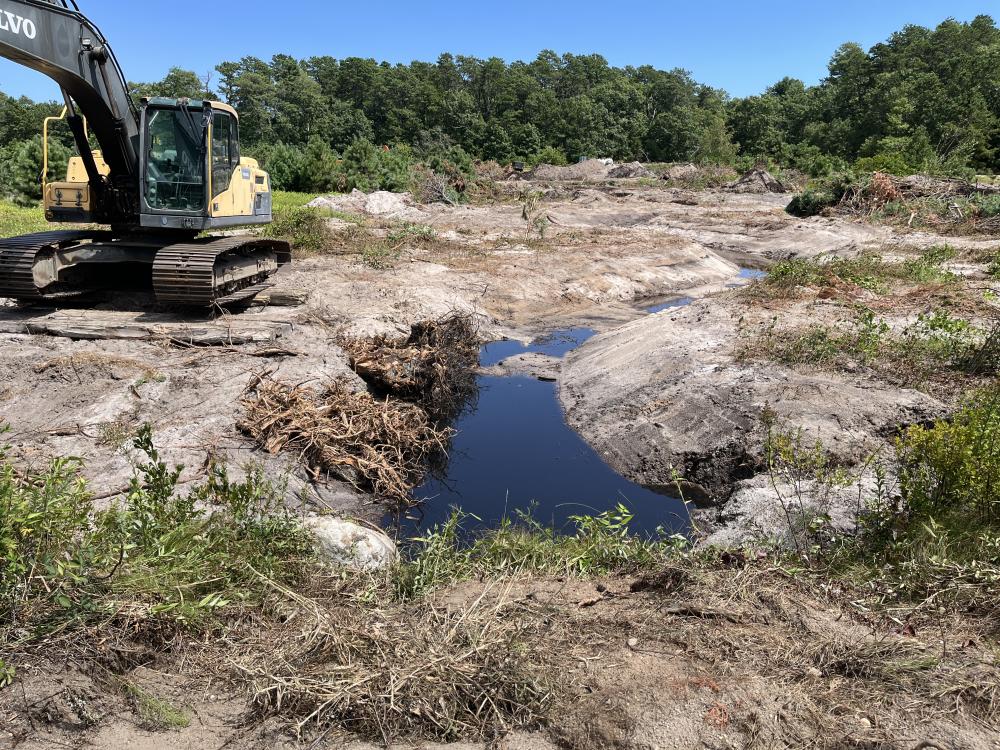 A newly dug, curvy part of Red Brook. Photo by Christian Uva
 Pitch pines that were removed are being left in the bog to provide a natural habitat for some wildlife. Photo by Christian Uva
 Excavators dig up and mix the soil. Photo by Christian Uva

 A newly dug, curvy part of Red Brook. Photo by Christian Uva
Pitch pines that were removed are being left in the bog to provide a natural habitat for some wildlife. Photo by Christian Uva
Excavators dig up and mix the soil. Photo by Christian Uva
A newly dug, curvy part of Red Brook. Photo by Christian Uva
Pitch pines that were removed are being left in the bog to provide a natural habitat for some wildlife. Photo by Christian Uva
Excavators dig up and mix the soil. Photo by Christian Uva
When you look out at Century Bog today, you’ll see a heap of downed pitch pine saplings, sand piles, shrubs and, of course, cranberry plants. What once was a picturesque Wareham cranberry bog is now a green-brown jumble. But to Sara Quintal, a restoration ecologist for Buzzards Bay Coalition, it’s a masterpiece.
“We want it to look messy,” she said.
It won’t look like this forever, but it’s part of the process to return the bog to its pre-farming state. The former 683-acre A.D. Makepeace cranberry farm is being restored by Massachusetts Division of Fisheries and Wildlife, or MassWildlife, and the Buzzards Bay Coalition. The work is the final step in a years-long process to restore Red Brook, which runs from Buttermilk Bay to White Island Pond in Plymouth.
The southern part of Red Brook was restored from 2006 to 2009, but there wasn’t enough funding to finish the project, said Mass Wildlife District Supervisor Jason Zimmer.
In 2022, however, the National Fish and Wildlife Foundation provided the restorationists with $4.9 million through its America the Beautiful Challenge Grant. With enough funding, the team is able to rebuild the stream in a more natural fashion and reconnect it to other bodies of water.
Returning a more robust ecosystem to the bog is the most important part of the project. “This is the centerpiece of the entire grant,” Zimmer said.
Century Bog used to be a large cranberry farm for A.D. Makepeace up until 2015. It operated as a run-of-the-river bog, which meant that it drew water from Red Brook.
Cranberry farming had a negative effect on the local ecosystem. Cranberries grow on sand, so farmers put thick layers of sand over the soil in bogs. This dries out the soil and pushes peat, which keeps the ground moist, out of reach of plants’ roots.
Chemical runoff from the farm had a negative consequence on the plants and wildlife in and around Red Brook. “Pesticides, herbicides, sand – it all impacts the stream ecosystem,” said Zimmer.
The stream was originally curved, but European colonizers artificially straightened it centuries ago, Quintal said. The plants that provided shade were removed over time, which raised the temperature and made it less hospitable for the trout in the stream.
The team debated how to restore it. Ultimately, it decided that it wanted to restore the land manually, which would lead to more effective land conservation. “When you have this highly impacted wetland, on the one hand we can walk away and let it revegetate how it will revegetate, but it won’t be as really high value,” Quintal said.
Buzzards Bay Coalition announced that work would begin on the site on Aug. 5. Soon after, excavators began ripping pine trees out of the ground and mixing the soil to bring the damp peat closer to the surface.
Quintal said that some areas already had native plant growth. Crews marked those shrubs with orange flags to make sure they stayed. Everything else is fair game for excavators.
The crews are also filling ditches that the farmers used to circulate water around the farm. The walls surrounding the bogs reached up to six feet tall in some places. Quintal said that the crews are flattening those walls to create a more even surface with a shallow gradient.
Some cranberry plants didn’t seem to get the memo that it’s not a farm anymore. A few stragglers remain in the wetlands. “We’re fine with cranberries being here, but we don’t want it to be only good for farming cranberries,” Quintal said.
Quintal said that the majority of restoration work will wrap up in December, and finishing touches will be made next spring.
The revamped bog will be a recreation area, with hiking paths around the land. But walkers won’t be the first people to benefit. “The fishermen will appreciate it first,” Quintal said.
The new Red Brook is designed to be a better fishing habitat, she said. Engineering firm Inter-Fluve, which is in charge of digging the new stream, decided to add natural-shaped bends to the stream. This will help to keep water flowing. Crews are also adding rootwads, which create cool, shady environments for trout and herring to rest.
The restoration project may also increase the biodiversity around Red Brook. Quintal said that after completing a similar project at Mattapoisett Bogs, visitors began noticing herons, which they had never seen there before.
“We’re restoring natural wetlands, and we’re restoring wildlife,” she said.